Say it with Gingerbread
At this time of year shop shelves are filled with “gingerbread men” or kits to build your own gingerbread houses. The dry, cakey, spiced biscuit which many think of as “gingerbread” is an offshoot (some might say poor relation) of the German Lebkuchen whose origins can be found in the region’s mediaeval monasteries in the 13th and 14th centuries, and to understand how they originated, we must begin with bees.

Medieval Beekeeping
Monastic or convent complexes in the middle ages would have included beehives. This illusration comes from a 1450s manuscript, the Pontifical of St Mary, in the Utrecht University Library.
An important part of monastic life in the Middle Ages was beekeeping. Beeswax was needed to manufacture large quantities of candles or wax votive offerings (figurines that would be left by pilgrims at a shrine) and at least some of the honey could be used to make sweet cakes, an age-old delicacy and a forerunner of the gingerbread we know today. Spices, arriving initially via Silk Roads routes and later from the New World, were expensive, but monasteries, convents and abbeys had the financial means to purchase them. Gradually their simple honey cakes became flavoured with an array of imported spices like cinnamon, cloves, nutmeg, cardamom and ginger. These were not purchased by such institutions for their flavour alone, but also for their medicinal properties, which were naturally of interest to the religious orders who were involved in caring for the infirm.
As the wider population gained a taste for “gingerbread”, its production gradually became an industry in its own right. Guilds for gingerbread bakers were established as stand alone entities or under the auspices of existing bakers’ guilds, although the strong links with religious institutions endured.

Nowadays we still find gingerbread shaped as Christian figures, for example angels or St Nicholas.
At certain times of the year, for example Christmas and Easter, monasteries and convents would distribute gifts, including gingerbread, to the local community. Records from a convent in Güntersthal in the Black Forest in the early 1500s reveal that the nuns bought an array of spices and arranged for a baker to instruct them in making Lebkuchen. These were then distributed to members of the local population depending on their age and status.
There were many reasons why gingerbread made a good present. As well as being delicious, it was robust and long lasting and lauded for the medicinal properties of the spices it contained. Especially when baked in elaborate shapes, it made an impressive souvenir or gift which displayed the wealth and worldliness of those who could enjoy it. Pieces of gingerbread were often shaped to represent religious figures, becoming an edible manifestation of the spiritual sustenance that the church and its institutions hoped to offer the wider population.
In 1487, the Holy Roman Emperor Friedrich III (the first of many members of the House of Habsburg to hold the title) distributed Lebkuchen figures of himself to thousands of children in Nuremberg and in the late 1500s Elizabeth I of England is supposed to have presented her courtiers, dignitaries and banquet guests with gingerbread versions of themselves.
To create such intricate confections bakers relied on skillful mould carvers who used materials such as pearwood which were hardwearing and did not affect the flavour of the gingerbread. Moulds from as early as the 17th century survive in good condition, and reveal the endless designs and creations being produced in gingerbread bakeries. Moulds were usually double sided and were used to create anything from saints to shepherdesses, animals to alphabets, hearts to heraldry, roosters to royalty.
Designs could also be created or enhanced by pressing seeds or nuts into the dough, by glazing it or even gilding the gingerbread with gold leaf. Nowadays lines of piped white sugar icing creating lace-like edges or conveying messages of love or good wishes are the most common style of decoration, and remind us that the act of giving gingerbread also developed romantic connotations. By the 18th century, when gingerbread was widely available and a staple of markets and fairs, it had become a customary gift between courting couples or a token to signal romantic interest from one person to another.
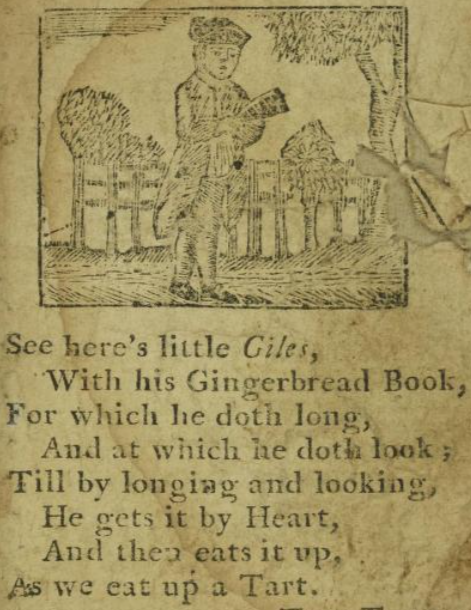
Giles Gingerbread
Giles’ gingerbread book is full of cautionary tales.
In the mid 1700s, the English publisher John Newbery, an early pioneer of children’s literature who lived between 1713 and 1767, published the Renowned History of Giles Gingerbread. It is the story of a boy who learns various lessons by consuming gingerbread books made for him by his father. Gingerbread is simultaneously the work, and the reward.
The story reminds us that from its earliest origins gingerbread was always more than a foodstuff, it was a medium which could be adapted to myriad purposes. A symbol of bodily and spiritual sustenance from Christian institutions, a tool for propaganda used by kings and emperors, a hopeful signal of romantic interest, a comforting harbinger of festivities or a way to learn life’s lessons, gingerbread has long been more than the sum of its luxurious, and delicious, parts.